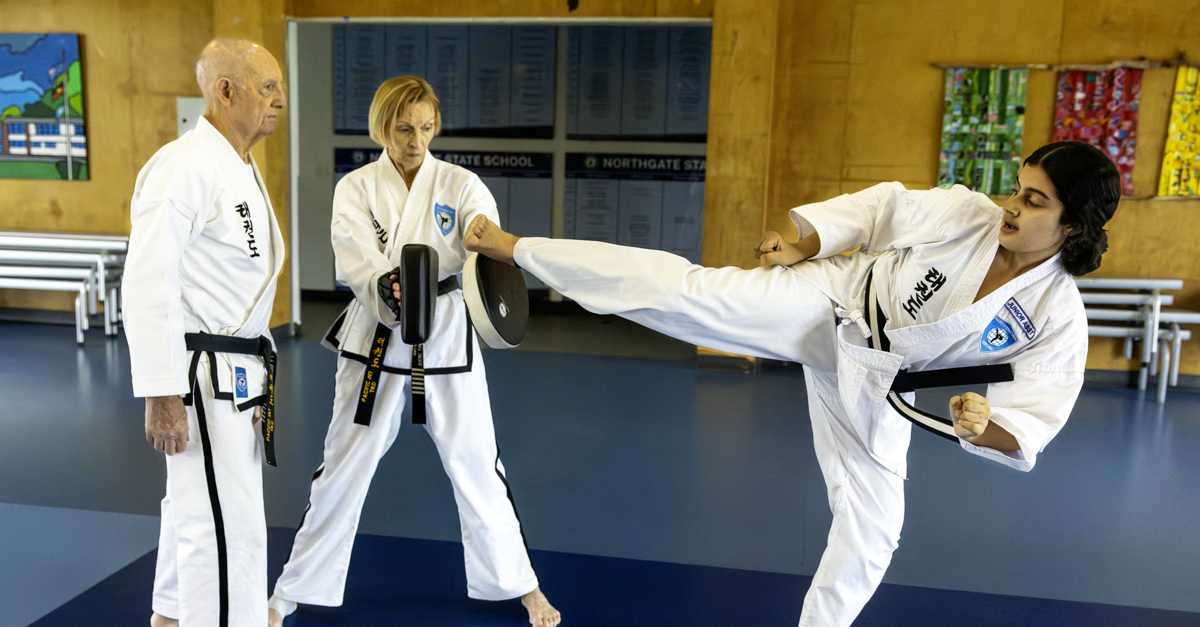
Improve your kicks with kicking shields
Kicking shields are one of the most versatile training tools in martial arts. Whether you’re practicing taekwondo, karate, muay thai, or MMA, these pads help you develop power, accuracy, and timing while keeping both you and your training partner safe.
Why Train with Kicking Shields?
Unlike heavy bags or static targets, kicking shields give you a mobile, reactive target that simulates real training conditions. Your partner can adjust height, angle, and position to help you work on specific techniques. The feedback you get from each strike helps you understand what’s working and what needs adjustment.
[IMAGE – Suggested: Partner holding a kicking shield in ready position, showing proper grip and stance. This demonstrates the “reactive target” concept and shows students what good holder technique looks like.]
Alt text: Training partner holding kicking shield with proper form and ready stance
Getting Started: Master Technique First
Before you focus on power and speed, nail down your technique. Start slow and controlled. Your training partner should hold the shield firmly and give you honest feedback about each kick. Once your form is clean, you can gradually increase speed and power.
Front Kick
[IMAGE – Suggested: Clear demonstration of front kick technique, ideally showing the chamber position or the moment of impact. A side angle that shows the straight trajectory would be ideal.]
Alt text: Demonstrating proper front kick technique with kicking shield in taekwondo training
Have your partner hold the shield at chest height. Focus on:
- Balance: Keep your standing leg stable throughout the movement
- Chamber: Bring your knee up first, then snap your foot forward
- Contact: Strike with the ball of your foot in a straight line
- Recovery: Retract your leg along the same path it traveled
Practice at three heights—low (knee level), mid (solar plexus), and high (head level). Each height requires different balance and hip positioning.
Roundhouse Kick
[IMAGE – Suggested: Powerful roundhouse kick showing hip rotation and proper form. The Balmoral gallery has some excellent examples of reverse kicks and high kicks that might work here. Look for images showing the circular path of the kick.]
Alt text: Student executing roundhouse kick with full hip rotation against training pad
Your partner should angle the shield to match the circular trajectory of the kick.
Key points:
- Pivot: Rotate on the ball of your standing foot
- Hip rotation: This is where the power comes from
- Strike surface: Use your instep or shin, depending on your martial art
- Follow through: Let your kick complete its arc naturally
Common mistake: trying to muscle the kick with your leg. The power comes from your hips and core rotation, not just your leg.
Side Kick
[IMAGE – Suggested: Clean side kick demonstration showing full extension and proper blade-of-foot positioning. An instructor or advanced student demonstrating would be ideal to show textbook form.]
Alt text: Advanced side kick technique demonstration at Pacific International Taekwondo
The holder needs to brace themselves well for this one—it’s a powerful kick when done right.
Focus on:
- Chamber: Bring your knee up toward your chest
- Extension: Push straight out with your heel
- Blade of the foot: This is your striking surface
- Alignment: Hip, knee, and ankle should form a straight line at full extension
Practice quick succession kicks—left, right, left—to build speed and endurance. For advanced practitioners, flying side kicks require the holder to be ready with proper stance and positioning.
Back Kick
This is essentially a reverse front kick with explosive potential.
Your partner should expect:
- Setup: You’ll turn your back to them briefly
- Look: Spot your target over your shoulder
- Heel strike: The heel drives straight back like a piston
- Balance: This kick requires excellent stability on your standing leg
Axe Kick
[IMAGE – Suggested: If you have any images of high kicks or overhead techniques, this would be a good spot. The axe kick is visually dramatic, so an action shot here would be engaging.]
Alt text: Practicing axe kick technique with overhead target in martial arts training
For this one, your partner might want to sit in a chair and hold the shield overhead, or stand and hold it high.
Technique essentials:
- Height: Raise your leg as high as your flexibility allows
- Downward drive: Bring your heel down forcefully
- Control: Don’t just let your leg fall—actively drive it down
- Balance: Keep your upper body upright throughout
Adjust the height of the target as you progress. Better to start lower and build up than to strain for height and lose form.
Spinning Kicks
Spinning kicks have countless variations. Coordinate with your partner beforehand on:
- What technique you’re practicing
- What height and angle they should hold the shield
- How much power you’ll be using (especially while learning)
Communication is key with spinning techniques. Your partner can’t always see what’s coming, so talk it through first.
The Holder’s Role
[IMAGE – Suggested: Two-person training shot showing the partnership aspect. Ideally something that shows the communication and teamwork between kicker and holder. Could be a moment between techniques where they’re adjusting position or discussing technique.]
Alt text: Training partners working together with kicking shield, demonstrating teamwork in martial arts training
Your training partner isn’t just a prop—they’re actively helping you improve:
- Positioning: They adjust height, angle, and distance to match your kick
- Feedback: They tell you what they felt—was it powerful? Off-center? Weak?
- Resistance: They provide the right amount of give—too much and you lose feedback, too little and someone gets hurt
- Coaching: They watch your form from a different angle than you can see
Switch roles regularly. Holding the shield teaches you about different kicks from a different perspective, and giving feedback makes you a better training partner.
Building Your Training Routine
[IMAGE – Suggested: Group training or class atmosphere shot showing multiple students working with pads. This reinforces the community aspect and shows the training in context.]
Alt text: Taekwondo class training with kicking shields at Pacific International Taekwondo
Start each session with technique work at low intensity. Once you’re warmed up and your form is solid, gradually increase power and speed. Mix up the heights and angles to keep your body adapting.
Quality beats quantity. Ten perfect kicks are better than fifty sloppy ones.
Safety Notes
- Start light and build up intensity
- Use proper protective gear when training at full power
- Communicate with your partner, especially during new techniques
- If something hurts (beyond normal muscle fatigue), stop and check your form
- Holders should position themselves safely, especially for powerful kicks
Next Steps
Once you’re comfortable with basic kicks on shields, you can progress to:
- Combination kicking (multiple kicks in sequence)
- Timing drills (partner moves the shield, you react)
- Power development (gradually increasing force)
- Cardio circuits (high-volume kicking rounds)
Kicking shields are durable training tools that can take years of intensive use. They should provide good shock absorption for the holder while giving you clear feedback on each strike.
[CLOSING IMAGE – Suggested: Inspirational shot of a student mid-technique or a satisfied/focused training moment. Something that captures the essence of dedicated training and improvement. Could be from a grading day or regular class.]
Alt text: Dedicated martial arts training at Pacific International Taekwondo Brisbane
Remember: the goal isn’t just to kick harder—it’s to kick better. Focus on technique, get feedback from your partner, and the power will develop naturally over time.
Looking for quality kicking shields and training equipment? At Pacific Sports, we’ve been supplying martial artists since 1972. Browse our range of multipurpose pads, focus mitts, and protective gear designed for serious training. Shop Training Equipment →