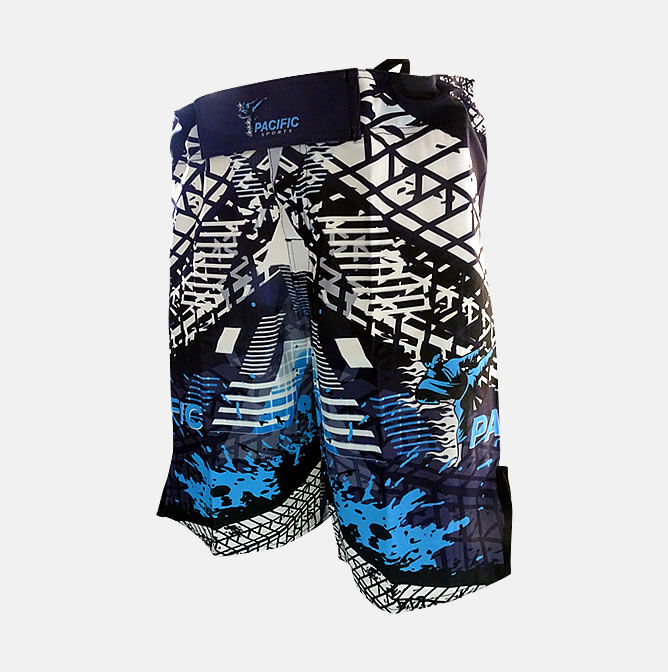
Pacific Sports kickboxing shorts for competition
Kickboxing Shorts: What Makes Them Different and the Four Types of Competition They’re Built For
Kickboxing shorts aren’t just training shorts with a different label. They’re specifically designed for the demands of the sport — the range of motion required for fast, powerful kicks, the waist security needed during dynamic movement, and the durability to handle regular high-intensity training and competition use. Understanding what makes a good kickboxing short also helps you understand the different competition formats you’ll encounter, because the demands on the shorts vary depending on how contact-heavy the event is.
What makes kickboxing shorts different
Freedom of movement for kicking
The most important design feature in any kickboxing short is the side split — a cut into the outer seam that opens fully when the leg rises. Pacific Sports kickboxing shorts combine side splits with a Lycra stretch flex panel at the split, which gives the fabric active stretch rather than just passive opening. The result is unrestricted hip rotation for roundhouse kicks, side kicks, and spinning techniques without the fabric pulling or creating drag.
Waist security
During fast combination work and spinning techniques, shorts that shift at the waist become a genuine distraction. Pacific Sports kickboxing shorts use three layers of waist security: an elasticated waistband for the base fit, an inner drawstring for precise adjustment to your specific waist size, and an improved Velcro closure for maximum security during movement. Together these keep the shorts firmly in place regardless of how dynamic the session gets.
Fabric and construction
Kickboxing shorts are made from 100% polyester or a polyester-satin blend. Polyester provides the structural strength — it’s lightweight but extremely durable, resistant to tearing even under the stress of repeated high-force kicks. Polyester-satin adds a characteristic shiny finish and softer feel against the skin while maintaining the same underlying strength. Stitching is doubly reinforced at pressure point areas — the waistband, the side splits, and the hem — where repeated stress from kicking is concentrated.
The inside left pocket is a practical addition — useful for a mouthguard, keys, or a phone between rounds. It’s a detail that competitors appreciate when other shorts force them to leave valuables unattended at courtside.
Care
Machine wash gentle or hand wash in cold water. The colours are sublimated into the fabric rather than printed on top, so they won’t fade or peel with regular washing. Fast drying — hang after washing and they’re ready for the next session quickly. Keep two pairs if you train daily.
The four types of kickboxing competition
Kickboxing competition comes in four distinct formats. The rules — and therefore the demands on your technique and your equipment — differ meaningfully between them.
Demonstrative competition
The purpose here is to exhibit technique rather than defeat an opponent. Kicks, punches, and other kickboxing techniques are performed and judged by a panel of experts. Points are awarded for the quality and variety of the techniques demonstrated, and the competitor with the highest score wins. This format rewards precision, creativity, and control — similar in spirit to kata in Karate.
Semi-contact — points competition
Competitors score points by landing controlled kicks and punches on the opponent. After each scoring technique the match is briefly paused, the point is awarded, and the action resumes. The points system varies between organisations but the general structure is:
- Any type of punch — 1 point
- Kick to the body — 2 points
- Kick to the head — 3 points
- Jumping kick to the head — 5 points
Techniques must be controlled and clean — the purpose is to score, not to hurt. Judges who determine that techniques were applied with excessive force can deduct points or disqualify a competitor. If the scores are level at the end of regulation, an additional round is given. If still tied, a sudden-death round determines the winner by whoever lands the first clean strike.
Semi-contact — continuous competition
The same points system and scoring logic as the points format, but the match runs continuously rather than pausing after each score. Bouts typically run three to ten rounds of two minutes each with one minute rest between rounds. The winner is the competitor with the most points at the final bell. This format demands better conditioning than the points format because there’s no recovery time built into the scoring process.
Full-contact competition
The same continuous format as semi-contact continuous, with one significant difference — techniques are delivered with full force. Knockouts are common and are the most decisive way to win. If the bout goes to the judges, points determine the winner. This is the format closest to professional boxing in terms of intensity and physicality, and the one that places the greatest demands on both competitor fitness and equipment durability.
In all four formats, the standard rules permit strikes above the waist and kicks to the side of the legs. Boot-to-boot leg sweeps and punches and kicks are generally allowed. Elbows and knees, grappling and clinch fighting, and direct kicks to the front of the legs are generally prohibited — though specific rules vary between organisations, so always check before competing.
Specifications
- Fabric: 100% polyester or polyester-satin blend
- Waist: Elasticated waistband, inner drawstring, Velcro closure
- Side splits: Yes — with Lycra stretch flex panel
- Pocket: Inside left, suitable for mouthguard or keys
- Stitching: Doubly reinforced at pressure points
- Sizes: S, M, L, XL — see size chart on product page
- Care: Machine wash gentle or hand wash, cold water, air dry
- Suitable for: Kickboxing, boxing, Muay Thai, MMA, CrossFit, gym training
Frequently Asked Questions
Can I wear kickboxing shorts for Muay Thai training?
Yes. The side splits and lightweight fabric work well for Muay Thai striking. The main difference is that Muay Thai shorts are typically shorter and have deeper side splits specifically to accommodate knee strikes in the clinch — a technique not used in kickboxing. For training that mixes both disciplines, kickboxing shorts handle both adequately. For dedicated Muay Thai training, purpose-made Muay Thai shorts give slightly better freedom for knee work.
What type of kickboxing competition should I enter first?
Semi-contact points competition is the most accessible entry point for new competitors. The pause-and-resume format gives you time to reset between exchanges, the controlled-contact requirement means lower injury risk, and the points system rewards technique over power — which suits practitioners who are still developing their competition experience. Full-contact competition is better suited to experienced practitioners with strong conditioning and well-developed sparring habits.
Do competition rules vary between organisations?
Yes, sometimes significantly. The points values, permitted techniques, round lengths, and equipment requirements can all differ between governing bodies. Before entering any competition, obtain and read the specific rules for that event and that organisation. Don’t assume that what’s permitted in club sparring matches what’s permitted in competition.
What size should I choose?
Check the size chart on the product page against your waist measurement. The elasticated waistband and inner drawstring give reasonable adjustment range, but the base size needs to fit your waist correctly. If you’re between sizes, the drawstring can compensate for a slightly larger size more comfortably than a too-small short can be stretched to fit.
How do I care for polyester-satin kickboxing shorts?
Machine wash gentle or hand wash in cold water. Don’t use hot water or tumble dry on high heat — both degrade the fabric faster. The sublimated colours hold up well to regular washing. Air dry after washing. Keep two pairs if you train daily so one can wash and dry properly between sessions.
Are kickboxing shorts suitable for bag work and pad work?
Yes. The same design features that make them suitable for competition — side splits, stretch flex panel, secure waist — work equally well for training sessions involving bags, pads, and partner drilling. The fabric durability handles the daily wear of regular training without the shorts losing their shape or integrity.