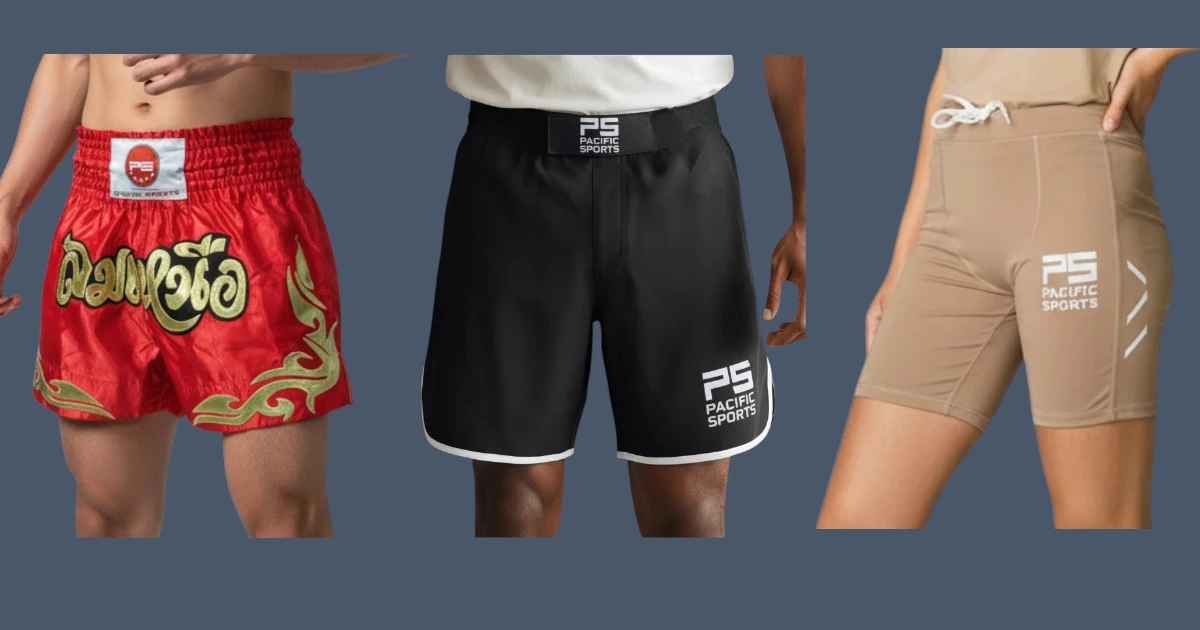
Differences between Muay Thai, Kickboxing, MMA and Compression shorts
Muay Thai, Kickboxing, and MMA Shorts: What’s the Difference and Which Should You Buy?
All three disciplines train in shorts, and at first glance Muay Thai, Kickboxing, and MMA shorts can look similar. They’re not. Each is designed with specific techniques in mind, and the differences in fit, cut, fabric, and design reflect those techniques directly. You can wear them interchangeably if you choose — and many practitioners do — but understanding what makes each type distinct helps you make a better buying decision.
Muay Thai shorts
Muay Thai shorts are the shortest and widest of the three. They’re cut well above the knee and have deep side splits — cuts into the outer seam that open up fully during movement. Both features serve the same purpose: allowing the full hip rotation required for Muay Thai’s kicking techniques, and — critically — allowing knee strikes without fabric restriction. Knee strikes are a fundamental weapon in Muay Thai that don’t appear in Kickboxing or standard MMA, and longer shorts would limit them significantly.
The fabric is typically polyester-silk or polyester-satin — polyester for durability, silk or satin for the characteristic lightweight, glossy feel that Muay Thai shorts are known for. The result is a short that feels almost weightless during training, which matters for kick speed.
The waistband is 10cm elasticated with an inner drawstring. The elasticated waistband keeps the shorts in place through fast spins and direction changes without requiring a tight fit; the drawstring allows fine adjustment for different body shapes.
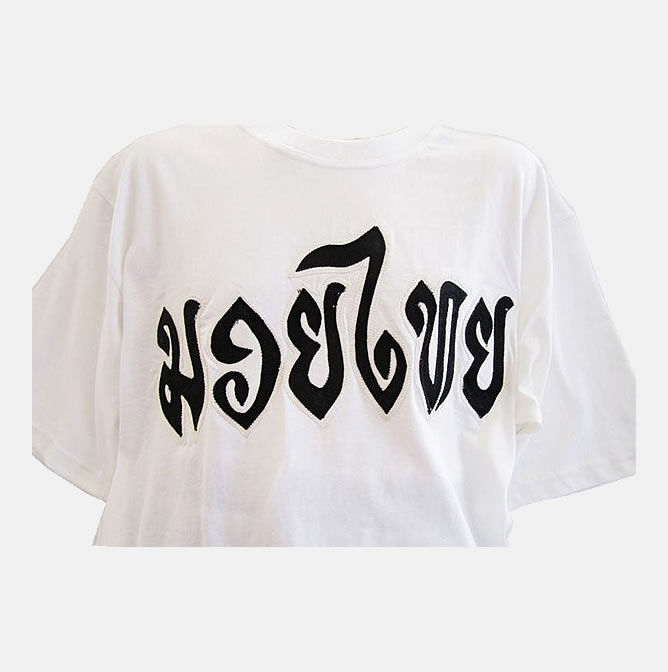
Muay Thai shorts are the most visually distinctive of the three — bold colours, traditional Thai lettering, and designs with cultural significance to the art. The “Muay Thai” lettering in Thai script is a deliberate connection to the heritage of the discipline.
Kickboxing shorts
Kickboxing shorts sit between Muay Thai and MMA in most respects — slightly longer than Muay Thai shorts but shorter than MMA shorts, with a medium to loose fit rather than the very wide cut of Muay Thai.
Side splits are standard on Kickboxing shorts for the same reason as Muay Thai — high kicks require unrestricted hip movement. The splits are typically less deep than Muay Thai shorts because knee strikes aren’t part of Kickboxing, so the extreme range of hip flexion that deep splits accommodate isn’t needed to the same degree.
The fabric is usually 100% polyester or a polyester-satin blend — durable, breathable, and fast-drying. The designs tend toward geometric patterns, stripes, and bold colour combinations rather than Thai lettering, reflecting Kickboxing’s distinct visual identity from Muay Thai.
The waistband construction is similar to Muay Thai shorts — elasticated with an inner drawstring for a secure, adjustable fit.
MMA shorts
MMA shorts are different from Muay Thai and Kickboxing shorts in several important ways. They’re longer — typically cut just above the knee — and either medium-loose fitting or tight-fitting like compression shorts, depending on the style.
MMA shorts don’t have side splits. This is because MMA involves grappling, takedowns, and ground fighting in addition to striking — side splits that work well for standing kicks become a liability during wrestling where the split edges can be grabbed or caught. Instead, MMA shorts are made from Lycra-polyester or spandex-nylon blends that provide stretch in all directions without needing splits to achieve range of motion.
The waistband on MMA shorts typically relies primarily on an inner drawstring rather than an elasticated waistband — a more secure closure for the multidirectional stress of grappling and ground fighting.
MMA shorts designs are generally more restrained than Muay Thai shorts — geometric patterns, solid colours, or subtle graphic elements rather than bold Thai lettering. This reflects the mixed heritage of MMA, which draws from multiple disciplines rather than one specific cultural tradition.
Some MMA shorts include a left inside pocket for a mouthguard, keys, or other small items — a practical detail that Muay Thai and Kickboxing shorts typically don’t have.
Can you use them interchangeably?
Yes, with some practical considerations.
Muay Thai shorts work well for Kickboxing — the additional range of motion they provide is never a disadvantage for kicking. For MMA, Muay Thai shorts can be used for striking-focused training but the wide, loose cut and side splits aren’t ideal for grappling rounds where excess fabric can be grabbed.
Kickboxing shorts work for Muay Thai training but the slightly longer length and less deep splits can limit knee strike range in clinch work. For MMA they have the same limitation as Muay Thai shorts during grappling.
MMA shorts work for all three disciplines in training, though the tighter cut feels different from the loose Muay Thai style and takes some adjustment if you’re used to the wider fit.
If you train multiple disciplines and want one pair that handles everything, MMA shorts are the most versatile choice. If you train primarily Muay Thai or Kickboxing, discipline-specific shorts give you a better fit for the techniques involved.
Is Muay Thai suitable for MMA?
Yes — with a few adjustments. Muay Thai brings significant striking weaponry to MMA: two fists, two elbows, two knees, and two shins — the art of eight limbs. The clinch game in Muay Thai, using knees and elbows from close range, transfers directly and effectively to MMA.
The adjustments needed are primarily in stance and footwork. Muay Thai stances tend to be more upright with weight loaded on the rear foot — useful for teeps and kick deflection, but it makes takedown defence harder. A slightly lower, wider stance with weight more evenly distributed is better suited to MMA where wrestling threats are constant.
Footwork also needs to adapt — Muay Thai often involves planting the lead foot to generate power, whereas MMA requires lighter, more mobile footwork to close distance, create angles, and defend against level changes. Muay Thai strikers transitioning to MMA also need to develop grappling, wrestling, and submission skills to fill the gaps that Muay Thai doesn’t cover.
With those adjustments made, Muay Thai is one of the most effective striking bases for MMA — the kicking range, the clinch control, and the elbow and knee weapons are all highly relevant in the cage.
What to look for when buying
Regardless of which type you’re buying, the key practical considerations are the same:
Fit: Check the size chart before ordering. Shorts that are too large shift during movement; too small and they restrict techniques. The elasticated waistband and drawstring give adjustment range, but the base size needs to be correct.
Fabric: Polyester-silk and polyester-satin for Muay Thai. 100% polyester or polyester-satin for Kickboxing. Lycra or spandex blend for MMA compression-style shorts. All fabrics should be fast-drying and easy to machine or hand wash.
Stitching: Check the side splits — reinforced stitching at the splits is essential. This is the highest-stress point in striking shorts and where cheaper shorts fail first.
Care: Wash after every session. Machine wash gentle or hand wash. Air dry rather than tumble dry on high heat. Keep two pairs if you train frequently so one can be washed while the other dries.
Specifications
- Muay Thai shorts: Polyester-silk or polyester-satin | Elasticated waistband with drawstring | Deep side splits | Well above knee | S, M, L, XL
- Kickboxing shorts: 100% polyester or polyester-satin | Elasticated waistband with drawstring | Side splits | Mid-length above knee | S, M, L, XL
- MMA shorts: Polyester-Lycra or spandex-nylon blend | Inner drawstring | No side splits | Just above knee | S, M, L, XL
- All styles: Reinforced stitching, non-fading colours, fast-drying, machine or hand washable
Frequently Asked Questions
Why are Muay Thai shorts so short compared to MMA shorts?
The short length and deep side splits allow unrestricted knee strikes — a fundamental Muay Thai weapon that longer shorts would limit. MMA shorts are longer because grappling and wrestling are part of the game, and the tighter Lycra-blend fabric provides range of motion without needing splits that could be grabbed during ground fighting.
Can I wear Muay Thai shorts for BJJ training?
For no-gi BJJ, Muay Thai shorts work in practice but the wide, loose cut and side splits can be grabbed during rolling — some training partners find this frustrating. MMA shorts or compression shorts are more practical for grappling-focused sessions where the fabric is less likely to interfere with technique.
What fabric is best for training in hot weather?
Polyester-silk and polyester-satin are both lightweight and breathable — well-suited to warm conditions. The glossy finish of satin doesn’t trap heat in the way heavier fabrics do. For training in hot, humid conditions like Queensland summers, the lightweight Muay Thai or Kickboxing short styles are more comfortable than heavier MMA board-short styles.
Do MMA shorts have pockets?
Some Pacific Sports MMA shorts include a left inside pocket suitable for a mouthguard, keys, or small items. Check the individual product page for the specific style you’re looking at — not all MMA shorts include this feature.
How do I care for polyester-silk and polyester-satin shorts?
Machine wash on a gentle cycle or hand wash in cold water. Don’t use hot water or tumble dry on high heat — both degrade the fabric faster. The colours and fabric hold up well to regular washing when cared for correctly. Keep two pairs if you train daily so one can wash and dry properly between sessions.
What size should I choose?
Check the size chart on the product page — shorts sizing varies between styles. The elasticated waistband and inner drawstring give reasonable adjustment range, but the base size needs to fit your waist measurement correctly. If you’re between sizes, the drawstring can compensate for a slightly larger size more comfortably than a too-small short can be stretched to fit.
All products sold at Pacific Sports undergo rigorous testing. Numerous gyms and martial arts schools of Australia and the world, rely on the Pacific Sports quality for tough and long-lasting products, which includes uniforms, jackets, pants, belts, shoes, rash guards, compression wear, protective wear and training gear. Additionally, products offered on sale carry this same high quality but with drastically reduced prices. Moreover, if the monthly newsletter is subscribed, then an additional 10% discount is also offered.
Few trending products: