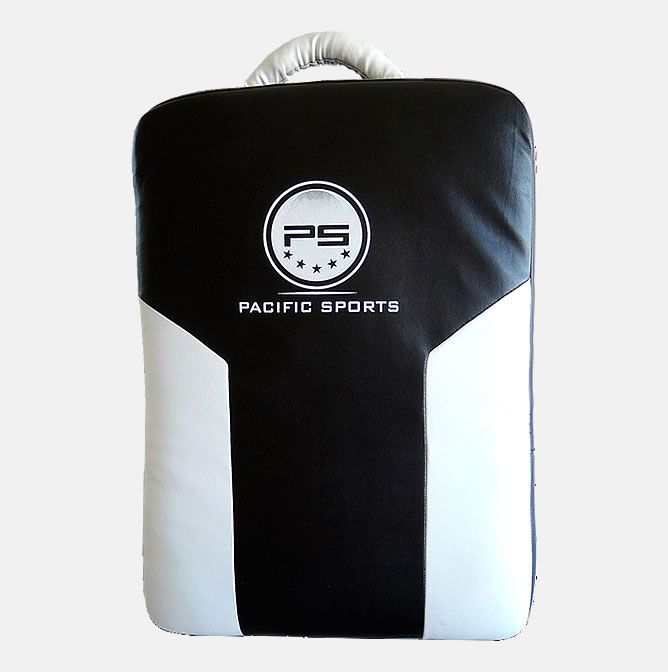
Pacific Sports Multipurpose Pads
Multipurpose Pads: A Complete Training Guide
A multipurpose pad — also called a kicking shield or kicking pad — is one of the most versatile pieces of training equipment you can own. Unlike focus mitts, which are primarily for punch combinations, or paddles, which are primarily for kicking accuracy, a multipurpose pad handles kicks, punches, knee strikes, and elbow strikes. One tool, all your striking surfaces. Here’s everything you need to know about choosing one and getting the most out of it. This guide covers multipurpose pads martial arts training Australia.
Flat or curved: which type to choose
Multipurpose pads come in two surface shapes — flat and curved. Both handle all types of strikes equally well. The difference is in how they sit for the holder.
The curved pad has a gentle concave shape that fits naturally against the holder’s chest and forearm when held close to the body. This ergonomic fit means the holder needs less active effort to keep it stable during powerful strikes — the shape does some of that work. It’s the more comfortable option for holders doing long sessions.
The flat pad provides a wider, uninterrupted striking surface that can be presented at more varied angles without the curvature affecting the contact point. For practitioners working on angled strikes, hooks, or elbow techniques that land at non-standard angles, the flat surface gives more versatility in how the pad is presented.
For most practitioners, either works. If you’re buying for a club where multiple people will be holding the pad, the curved version tends to be more universally comfortable across different body types.
Construction: what to look for
A multipurpose pad gets hit thousands of times. Construction quality directly determines how long it lasts and how well it protects the holder.
Pacific Sports multipurpose pads use three layers of high-impact, high-density shock-absorbing foam inside. The layered construction distributes force more effectively than a single foam layer of equivalent thickness — each layer absorbs part of the impact before passing the remainder to the next layer, so the force reaching the holder’s arm is significantly reduced. The exterior is Tough synthetic PU leather that resists tearing even under repeated full-power strikes.
Dimensions: 56cm x 40cm x 11cm. Weight: Approximately 900g each. The size gives a large enough striking area for all kick types including head-height kicks; the 11cm thickness provides adequate protection for the holder’s forearm at full power. The weight keeps the pad manageable for the holder to move and reposition without fatigue.
The holding system
The back of the pad has three grip points: two Velcro hook-and-loop straps — one at the wrist, one at the forearm — and a solid riveted handle at the top. The forearm area also has additional padding to protect the holder’s arm from transferred impact.
This three-point system matters more than it might seem. A pad held by a single handle shifts and rotates under impact. A pad secured at the wrist and forearm with a top handle for repositioning stays exactly where the holder places it, which means the kicker gets consistent target placement and the holder doesn’t have to fight to control the pad between strikes.
How to hold the pad: guidelines for the holder
The holder’s job is to keep the pad stable, protect themselves, and give the kicker meaningful feedback. Technique matters.
Take a stable stance — an L-stance or walking stance — before the kicker begins. A holder who is easily pushed back isn’t providing real resistance and isn’t helping the kicker develop power.
Hold the pad as close to your body as possible. The closer the pad is to your body, the more of the strike force your body mass absorbs through the pad rather than your arm absorbing it alone. A pad held at full arm extension transfers far more force to the holder’s arm and shoulder than one held tight to the chest.
For low and mid front kicks or straight punches, hold the pad against your chest — one hand gripping the top, one hand gripping the bottom. For side strikes, use the back handles including the top riveted handle and angle the pad appropriately. For high strikes, a paddle is usually better than a multipurpose pad — the pad becomes awkward to hold at head height for extended periods.
After each strike, give the kicker specific feedback about where the strike landed and how much force you felt. The holder’s real-time feedback is one of the most valuable aspects of pad training — it tells the kicker immediately what’s working and what needs adjustment.
What you can practice on a multipurpose pad
This is where multipurpose pads genuinely earn their name. The striking surfaces you can practice are significantly broader than most practitioners realise.
Arm techniques
The pad accommodates the full range of arm striking surfaces:
- Fingers — for practising finger jabs
- Open hand — for palm strikes, backhand strikes, and knife-hand strikes
- Closed fist — in multiple variations for different punch types
- Wrist — for improving wrist flexibility under impact
- Forearm — inner and outer, for practising blocks
- Elbow — at different angles for elbow strikes, particularly relevant in Muay Thai
- Upper arm — biceps and triceps for conditioning grappling and throwing muscles
- Shoulder — for pushing and throwing movement conditioning
Leg techniques
Similarly, the full range of leg striking surfaces:
- Ball of the foot — for striking front kicks
- Sole of the foot — for pushing front kicks and teep
- Foot-sword (blade of the foot) — for piercing side kicks
- Heel — for spinning heel kicks and back kicks
- Instep — for swinging roundhouse kicks
- Ankle — for ankle conditioning
- Shin — for blocks and deflection practice
- Knee — for knee strikes in Muay Thai and MMA clinch work
- Thigh — for block and deflection conditioning
The breadth of what can be practiced on a multipurpose pad is what separates it from more specialised equipment. A paddle develops kicking accuracy. Focus mitts develop punch combinations. A multipurpose pad develops everything, which is why it’s often the first piece of training equipment a serious practitioner buys.
Multipurpose pads as a bridge to sparring
One of the most practical applications of multipurpose pads is as preparation for sparring. Pad work allows you to deliver full-power strikes without injuring a training partner, which means you can develop the power, timing, and combination flow that light sparring doesn’t allow — and do it safely. Once those qualities are established on the pads, transferring them into controlled sparring is a natural next step.
Both partners benefit from every session. The kicker develops technique and power; the holder develops body awareness, coaching eye, and the ability to read and respond to incoming strikes. Switch roles regularly.
Care and maintenance
Wipe the striking surface, back, handles, and straps with a damp cloth after every session. Sweat and bacteria accumulate on every surface — not just the part that gets hit. Air dry fully before storing. Don’t seal the pad in a bag while still damp. Stored correctly, Pacific Sports multipurpose pads are built to withstand thousands of full-power strikes over years of regular training.
Specifications
- Available as: Curved or flat surface
- Dimensions: 56cm x 40cm x 11cm
- Weight: Approximately 900g each
- Padding: 3 layers high-impact, high-density foam
- Outer material: Tough synthetic PU leather
- Handles: Two Velcro straps (wrist and forearm) plus riveted top handle
- Extra forearm padding for holder protection
- Suitable for: All striking disciplines — Taekwondo, Karate, Muay Thai, MMA, Kickboxing, Kung Fu, Wing Chun
- Sold as: A pair
Frequently Asked Questions
What’s the difference between a multipurpose pad and a focus pad?
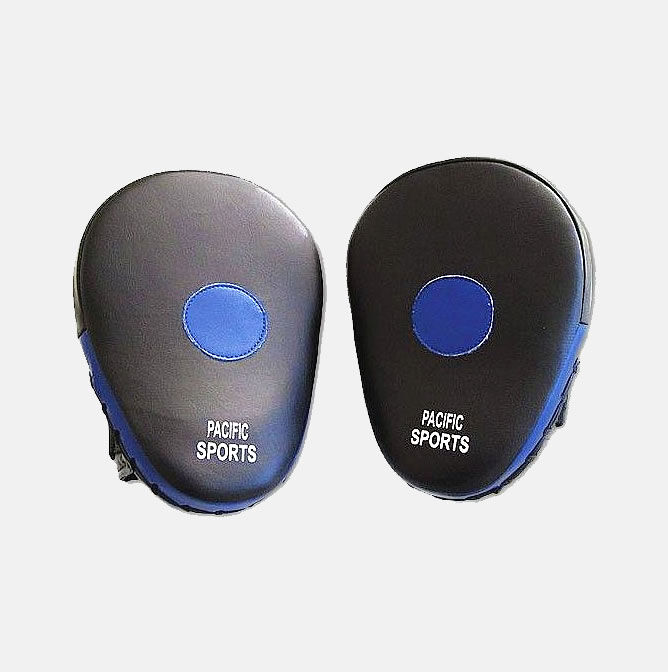
Focus pads are smaller, lighter, and held in the hands like gloves — primarily designed for punch combinations and head-height targeting. Multipurpose pads are larger, held against the body, and designed to absorb full-power kicks, knee strikes, and elbow strikes in addition to punches. They serve different purposes in a training session — focus pads for precision combination work, multipurpose pads for power development across all striking surfaces.
Can one person hold both a multipurpose pad and a focus pad simultaneously?
Yes — this is standard in Muay Thai combination training. The multipurpose pad is held in one hand for kick and knee targets; a focus pad is held in the other for punch and elbow targets. Both Pacific Sports products are light enough for a partner to hold one of each comfortably throughout a session.
Are multipurpose pads suitable for children’s training?
Yes, with appropriate supervision. The large striking surface accommodates less precise technique, which suits developing practitioners. An adult should always be the holder for children’s sessions — a child doesn’t have the body weight and stance stability to absorb full-power strikes from another child safely, and the adult holder can moderate the intensity appropriately.
How do I know if the holder is positioned correctly?
If the holder is being pushed back noticeably with every strike, they either aren’t bracing correctly or their stance is too narrow. A well-positioned holder absorbs most of the force through their body mass — the pad should stay relatively stable on impact rather than the holder’s whole body moving backward. The kicker should also feel real resistance from a well-held pad — if it gives too easily, the holder isn’t holding firmly enough to provide meaningful feedback.
Can multipurpose pads be used for solo training without a partner?
Not effectively — the pad needs to be held to provide resistance and meaningful feedback. Without a holder, the pad just falls over. For solo training, a heavy bag provides more practical benefits. Multipurpose pads are specifically partner training equipment.
How often should I clean the pads?
After every session. Wipe all surfaces — striking face, back, handles, and straps — with a damp cloth. Bacteria from sweat and skin contact accumulate on all surfaces, not just the striking face. Air dry fully before storing. Pads cleaned and aired consistently last significantly longer than pads stored sweaty in a bag.