What is a Dobok?
What Is a Dobok? The Taekwondo Uniform Explained
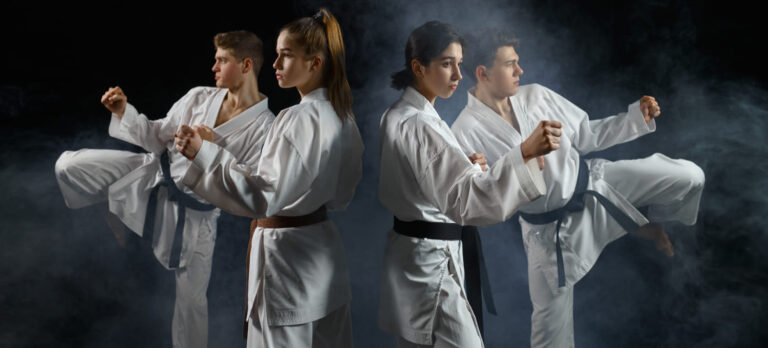
If you train Taekwondo, you wear a dobok. If you’ve ever wondered, what is a dobok, where the word comes from, why the jacket looks the way it does, or why there seem to be two different styles — one with a V-neck and one that closes vertically — this post answers all of that.
What does “dobok” mean?
The word dobok comes from two Korean words: do, meaning “way” or “path”, and bok, meaning “clothing”. So a dobok is literally “clothing for the way” — the attire worn by someone walking the path of Taekwondo. This mirrors the philosophy embedded in the art itself, where training isn’t just physical exercise but a way of developing character and discipline over time.
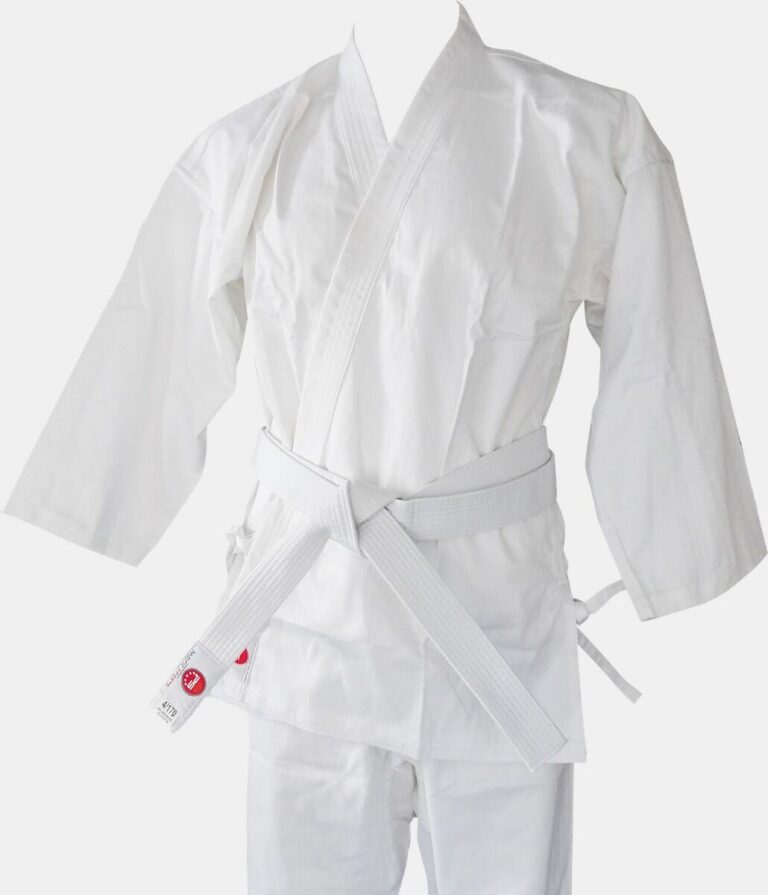
Like the gi in Karate, Judo, and BJJ, the dobok consists of a jacket and pants, with the belt purchased separately according to your rank colour.
Where the dobok’s design comes from
The dobok didn’t emerge from nothing. Its design carries influences from three distinct traditions, and understanding these helps explain why it looks the way it does.
Influence from the Japanese keikogi
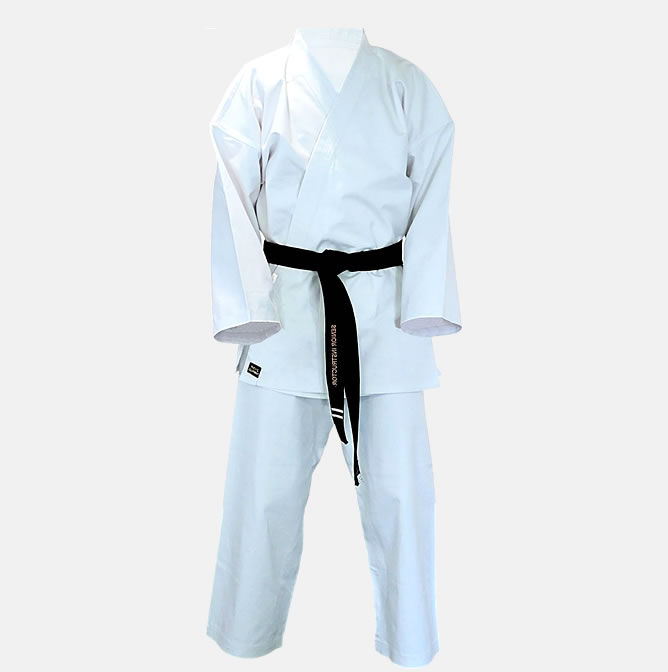
When Taekwondo was formalised in Korea in the mid-20th century, Korean martial artists were already familiar with Japanese martial arts and their uniform — the keikogi used in Judo and Karate. The early dobok reflected this influence directly: a cross-over jacket with two front lapels, the left crossing over the right and held in place by the belt. This is the same jacket structure used in Karate and Judo gi.
Traditional schools of Taekwondo — particularly those following the ITF (International Taekwondo Federation) style — still use this cross-over jacket front. The jacket closes vertically rather than pulling over the head, and the lapels sit flat across the chest when the belt is tied.
Influence from the Korean hanbok
As Taekwondo developed its own distinct identity, particularly through the World Taekwondo (WT) federation, the dobok evolved away from the Japanese keikogi style and toward something uniquely Korean. The jacket transformed into a V-neck design inspired by the hanbok, the traditional Korean dress. Rather than crossing lapels, the WT-style jacket pulls over the head like a shirt, with a clean V-neck collar.
This is the most visible distinction between the two main styles of dobok you’ll encounter:
- WT (World Taekwondo) style — V-neck pullover jacket, worn in Olympic-style Taekwondo
- ITF (International Taekwondo Federation) style — vertically closing cross-over jacket, worn in traditional ITF Taekwon-Do
In some schools, the jacket features a black collar to indicate that the wearer holds a black belt — a specific visual identifier that tells students and visitors about the wearer’s rank at a glance.
Influence from the hakama
A less common but interesting variation of the dobok appears in Keomdo, the Korean sword art. Keomdo practitioners wear a dobok with wider, flowing pants called chima baji — similar in appearance to the hakama worn in Japanese sword arts like Kendo and Iaijutsu. This reflects the shared heritage of East Asian martial arts traditions across the region.
Dobok colours
White is the traditional dobok colour and remains the standard across most schools and competitions. It carries the same symbolic meaning as white gi in other arts — purity, humility, and the beginner’s mind.
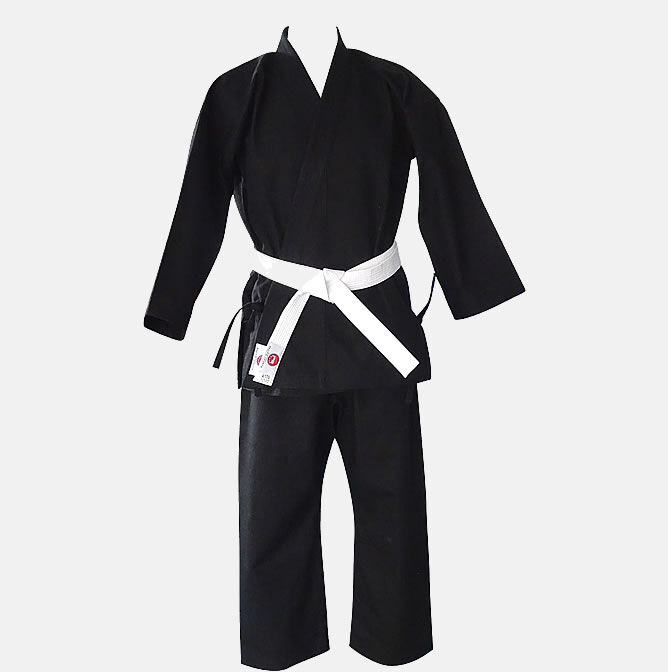
Black doboks are also worn, particularly by higher-ranking practitioners and instructors in some schools. Other colours exist but are less common in formal training and competition contexts.
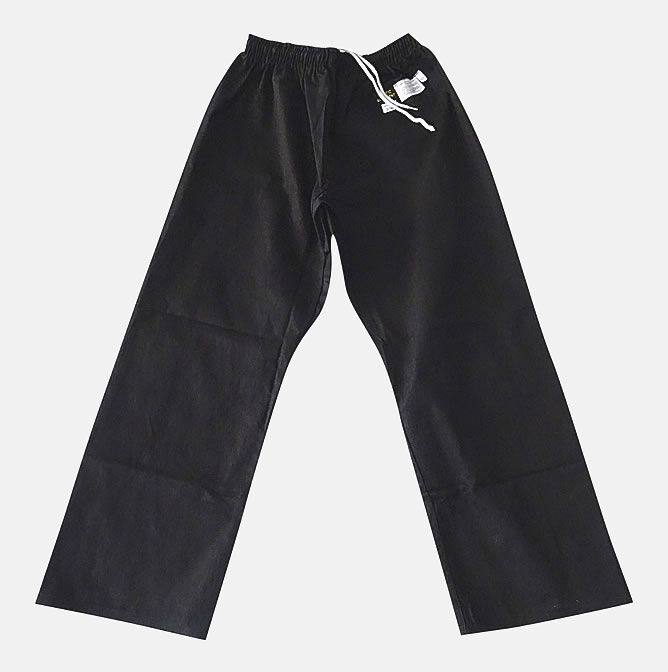
A practical note specific to Taekwondo: some schools have black belt students wear black pants with a white jacket, rather than a fully black dobok. This allows the rank distinction to be visible without requiring a completely different uniform. If your school follows this convention, you can buy black pants separately rather than purchasing a complete new dobok.
As always — ask your instructor before buying anything other than white. Different schools, different organisations, and different competition rules have different requirements, and getting it wrong before your first grading is an easily avoided mistake.
Dobok fabric and weight
Doboks are made from cotton, canvas, or a poly-cotton blend. The choice affects weight, breathability, and durability.
Cotton is the traditional preference — it breathes well, absorbs sweat during training, and feels comfortable against the skin even in hot conditions. Pure cotton does shrink in washing, so wash cold and buy your regular size whether the dobok is pre-shrunk or not.
Canvas is also 100% cotton but woven more densely, making it heavier and more durable. Heavier canvas doboks produce a satisfying snap on crisp techniques — a sound that signals the crispness of the movement. They’re better suited to advanced practitioners who train hard and want maximum longevity.
Poly-cotton blends are lighter, shrink less, and dry faster. For beginners or for training in hot climates like Queensland summers, a lightweight 8oz poly-cotton is the practical starting point.
How the dobok is designed for Taekwondo
Every design feature of the dobok serves the specific movement demands of Taekwondo.
The jacket is cut generously through the shoulders and chest to allow the full range of punching and blocking techniques without pulling tight. Unlike a BJJ or Judo gi where the jacket needs multiple reinforced stitching lines to withstand grabbing, the Taekwondo dobok jacket is designed for freedom of movement in striking rather than resistance to gripping.
The pants have a gusseted crotch — an extra panel of fabric in the inner seam — specifically to allow high kicks without stressing the seams. Taekwondo’s kicking-heavy technique puts more stress on the pants than almost any other gi-based martial art. Without a gusset, the inner seam would split regularly during training. The elasticated waistband with inner drawstring keeps the pants secure through fast direction changes and spinning kicks.
Caring for your dobok
The same rules apply as for any gi. Wash after every session in cold water — sweat left in cotton fabric becomes a breeding ground for bacteria within hours. Air dry rather than tumble dry to prevent heat-shrinking the fabric. Don’t use bleach or fabric softener — bleach degrades the threads and fabric softener coats the weave and traps bacteria rather than removing it. For gradings and competitions, iron your dobok so it looks sharp. For regular training, don’t bother — body heat smooths out the wrinkles within minutes of starting.
Keep at least two doboks if you train regularly. One needs to be washed after every session and properly dried — with only one dobok, you’re either skipping the wash or missing training while it dries.
Frequently Asked Questions
What’s the difference between a dobok and a gi?
Functionally they’re the same thing — a jacket, pants, and belt for training in a gi-based martial art. The dobok is the Taekwondo-specific version. The main visual difference is the jacket: a traditional gi has overlapping cross-over lapels held in place by the belt, while the modern WT-style dobok has a V-neck collar that pulls over the head. The ITF-style dobok retains the cross-over jacket similar to a traditional gi.
Which style of dobok should I buy — WT or ITF?
Ask your instructor before buying. Which style is appropriate depends entirely on which organisation your school is affiliated with. WT schools use the V-neck style; ITF schools use the vertically closing cross-over style. Turning up with the wrong jacket style is easily avoided by asking first.
Does my dobok come with a belt?
Pacific Sports doboks include a white belt. When you’re graded and need a new belt colour, belts are sold separately in all colours. Your belt size corresponds to your dobok size — a size 4 dobok takes a size 4 belt.
Can I wear my Taekwondo dobok for Karate or other martial arts?
For casual cross-training, yes — the construction is similar enough that a dobok works for Karate training at club level. For formal Karate training or competition, the V-neck style may not be accepted — most Karate organisations require the traditional cross-over lapel jacket. Check with your instructor.
How do I know what size dobok to buy?
Doboks are sized by height, not by the height-and-width combination of regular clothing. If your chest or waist is larger than average for your height, buy the size that fits your widest measurement and have the sleeves or legs shortened if needed. A dobok that’s slightly too long is easy to fix; one that’s too tight across the chest or thighs restricts every technique you attempt. See our full sizing guide for details.
Should I wear shoes with my dobok?
Traditional Taekwondo is practiced barefoot, and most competitions don’t allow shoes. For long training sessions, outdoor training, or if you’re recovering from a foot injury, Taekwondo shoes are practical. They feature a pivot point on the sole specifically designed for the spinning and turning kicks central to Taekwondo. See our Taekwondo shoes guide for more detail on when and why to wear them.
Understanding what is a dobok Taekwondo uniform is essential for anyone training in this martial art.
This post explores the significance of the dobok and answers the question: what is a dobok Taekwondo uniform?
Understanding what is a dobok Taekwondo uniform is essential for anyone training in this martial art.