What to know when buying Karate Pants?
Karate Pants: Gusseted Crotch, Waistband Options, and Choosing the Right Fabric
Karate pants look simple but there are several construction and fabric decisions built into them that directly affect how they perform in training. Understanding these details helps you buy the right pair first time rather than discovering their limitations after a few sessions. This article serves as a comprehensive karate pants buying guide Australia.
The gusseted crotch: why it matters
Every quality martial arts pant is made with a gusseted crotch. This is an extra panel of fabric sewn into the inner seam — it’s the feature that allows the pants to open fully during high kicks, deep stances, and wide stretches without stressing the seams.
Without a gusset, the inner seam of the pants is under direct tension every time you raise your leg above hip height. Over time — or sometimes immediately — this leads to seam splitting at exactly the point where the stress is greatest. A gusseted crotch distributes that stress across the additional panel, which both prevents splitting and significantly extends the life of the pants.
For Karate specifically, where front kicks, roundhouse kicks, and side kicks at head height are fundamental techniques, a gusseted crotch isn’t optional — it’s essential. Check for it before buying any martial arts pants.
Waistband: tie strap or elasticated?
Karate pants are secured at the waist in one of two ways.
The traditional tie strap threads through loops on the front of the pants and ties securely at the front. It gives a very adjustable, secure fit but takes slightly longer to put on and requires retying if it loosens during training.
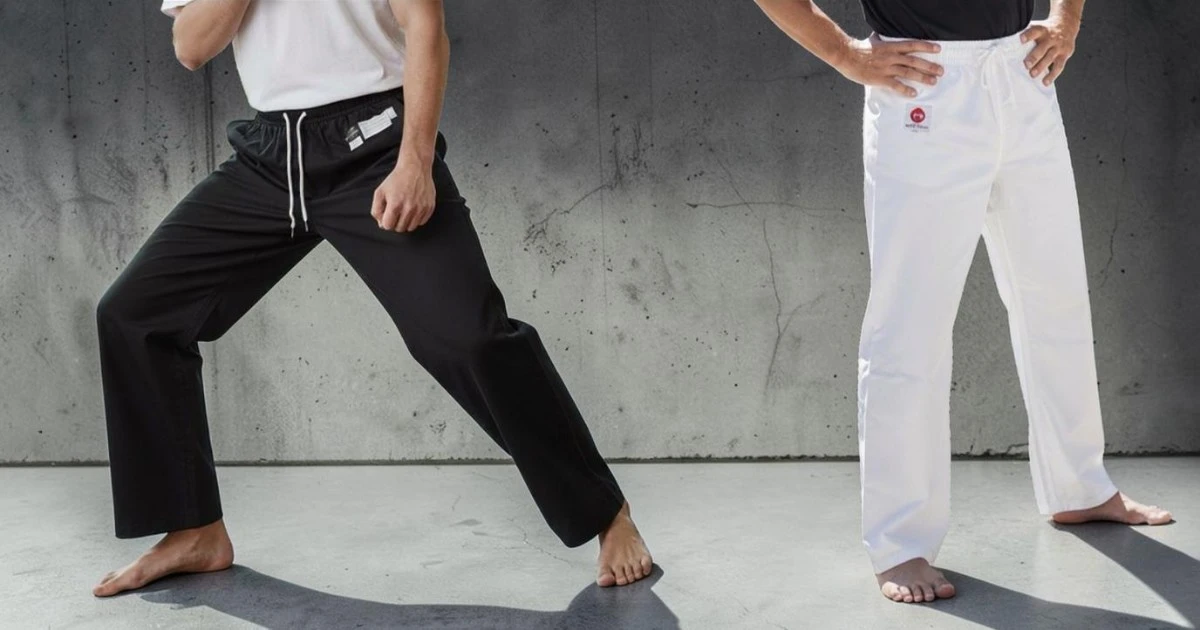
The modern elasticated waistband with inner drawstring works like a good pair of training pants — the elastic provides the base fit and the drawstring allows fine adjustment. This is the more popular choice for most practitioners and the one Pacific Sports gi pants use.
For children, the elasticated waistband is the clear practical choice — easier to put on independently, no tie to come undone mid-class, and simpler to manage at the age when kids are still developing fine motor skills.
Fabric: which type suits your training?
Karate pants come in three main fabric types, each with a different profile of comfort, care requirements, and cost.
Poly-cotton blend
The most widely available and least expensive option. Poly-cotton is lightweight, durable, and easy to care for — machine wash and hang to dry, no special treatment needed. Shrinkage is minimal compared to pure cotton. This is the sensible choice for beginners, children, and anyone who wants reliable performance without additional care requirements.
The one practical limitation is that poly-cotton can become slightly see-through and clingy when saturated with sweat. This isn’t a quality issue — it’s simply how the synthetic component in the fabric behaves. For most training it’s not a concern, but it’s worth knowing.
100% cotton
Cotton breathes significantly better than poly-cotton — it’s a natural fibre with an open structure that allows heat to escape rather than trapping it against the skin. In warm conditions or long training sessions, the comfort difference is noticeable.
The trade-offs are real though. Cotton shrinks — check whether the pants are pre-shrunk before buying. After the first wash there’s usually some residual shrinkage, so always wash cold and air dry. Cotton also creases, so you’ll need to iron them before formal occasions like grading. For regular training, a few wrinkles aren’t worth worrying about.
Despite the extra care required, most experienced practitioners who try 100% cotton don’t go back — the breathability and comfort justify the additional attention.
Canvas
Canvas is 100% cotton woven more densely than standard cotton — heavier, stiffer, and more durable. It comes in multiple weights and is typically the choice of intermediate to advanced practitioners.
One characteristic of canvas that surprises people: despite being heavier than poly-cotton or standard cotton, it often feels cooler to wear. The stiffer fabric stands away from the skin rather than lying against it, which creates a small air gap that allows sweat to evaporate more effectively. In heavy canvas weights, this effect is pronounced enough that some practitioners find 14oz canvas more comfortable in summer than lightweight poly-cotton.
The canvas weights and what they suit:
10oz–12oz lightweight canvas — the natural first step up from poly-cotton or standard cotton. Heavier than what you’re used to but not restrictive. The canvas produces the satisfying snap on techniques that lighter fabrics don’t. Suitable for intermediate practitioners and anyone wanting to try canvas for the first time.
14oz medium-weight canvas — the balance point between weight, durability, and wearability. Stiffer and more substantial than 12oz but still comfortable for extended training. The choice of most experienced students and instructors for regular training and formal occasions.
16oz–18oz heavyweight canvas — the most durable and the most professional looking. Outstanding snap on techniques. However, the weight is genuinely restrictive for smaller or lighter-framed practitioners, and it takes adjustment for anyone not used to training in heavier fabric. Best suited to larger-framed practitioners, senior instructors, and competitors doing kata demonstrations where the appearance and sound of the uniform matters. Not recommended for beginners.
Black karate pants
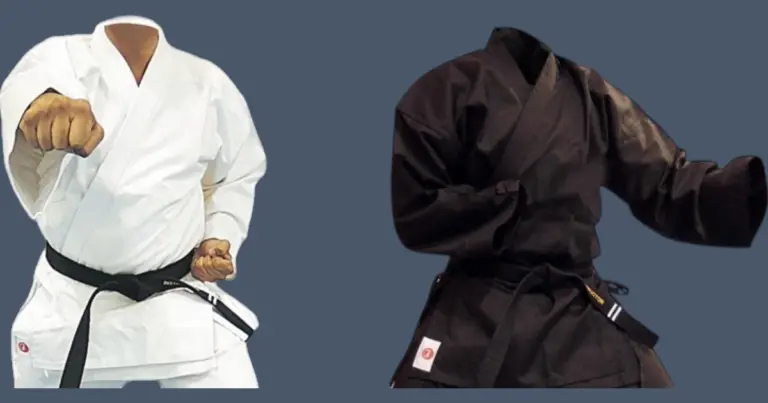
Karate pants are available in black as well as white. Black pants are sometimes worn as part of a two-tone uniform — white jacket with black pants — or as part of a fully black gi. Check with your instructor before buying black pants if you’re unsure whether your school permits them for training or grading.
Sizing
Gi pants are sized by height rather than waist size, which means if your waist is broader than average for your height, you should buy a size up and have the length altered if needed. A tailor or alterations shop can shorten gi pants easily — this is a straightforward hemming job. Check the size chart on the product page for the specific pants you’re ordering, as sizing can vary between fabric weights and styles. See our full martial arts uniform sizing guide for measuring instructions.
Frequently Asked Questions
Do all karate pants have a gusseted crotch?
Quality karate pants do — and you should check before buying. A gusseted crotch is essential for kicking arts. Pants without a gusset will restrict high kicks and are likely to split at the inner seam over time. If the product description doesn’t mention a gusseted crotch, contact the seller and ask before ordering.
What waistband type is better for children?
Elasticated waistband with drawstring. It’s easier for children to manage independently, doesn’t require tying in the traditional way, and is more forgiving of slight size variations as children grow. The traditional tie strap is better suited to adult practitioners who prefer a very precise, adjustable fit.
Will canvas pants shrink?
Yes — canvas is 100% cotton and will shrink, particularly in the first wash. Pre-shrunk canvas pants have already undergone initial shrinkage during manufacturing and will shrink minimally further. Non-pre-shrunk canvas pants are made with a shrinkage allowance built in. Either way, buy your regular size and always wash cold. Hot water accelerates shrinkage beyond the intended allowance.
Can I buy just pants without buying a complete gi?
Yes. Pacific Sports sells gi pants individually across all fabric types and weights. This is useful when one piece of your gi wears out before the other — in Karate and Taekwondo, the pants typically wear faster than the jacket because kicking puts more stress on the fabric. See our post on buying gi separates for more detail.
Are 16oz canvas pants suitable for competition?
For kata competition, yes — the weight and snap of heavy canvas is actually advantageous for the crisp, audible technique feedback that kata judges assess. For sparring-based competition with multiple rounds, the weight may become fatiguing if you’re not accustomed to training in heavy canvas. Most experienced competitors who use 16oz canvas for kata have a lighter-weight pair for sparring events.
How do I care for canvas karate pants?
Machine wash cold with mild detergent. No bleach — it degrades cotton threads. No fabric softener — it coats the weave and reduces breathability. Air dry rather than tumble dry. Iron when needed for grading and competition; skip it for regular training. Store folded rather than crumpled in a bag — canvas creases at pressure points that can eventually weaken the fabric at those spots.