Taekwondo shoes guide: benefits, features and sizing
Taekwondo Shoes Australia: Why You Need Them, What to Look For, and How to Choose the Right Size
Taekwondo is traditionally practiced barefoot, and in most competitions you won’t be allowed to wear shoes. So it’s reasonable to ask — why wear them at all? The answer is that barefoot, shoes, and foot protectors each serve a different purpose in your training, and relying only on one approach leaves gaps that will eventually cost you training time through injury or discomfort.
Train all three ways
This is the most practical framework for footwear in Taekwondo, and it comes from 35 years of coaching experience.
Train barefoot regularly to develop the sensitivity, balance, and technique that comes from direct contact with the floor. This is how you perfect your kicks and how you’ll need to perform in most competitions. Don’t abandon barefoot training just because you have shoes.
Train with foot protectors so you’re comfortable wearing them in competitions that require them. If you’ve only ever trained barefoot, wearing foot protectors in a competition for the first time is a distraction you don’t need.
Train with shoes for long sessions, heavy drilling, and outdoor training. Shoes allow you to train for extended periods without accumulating the foot injuries that come from repeated impact on hard surfaces over time.
Why shoes matter for long training sessions
The problem with training barefoot isn’t technique — it’s accumulation. One session barefoot is fine. Two hundred sessions barefoot over months of intensive training is where the injuries add up. Here’s what repeated barefoot training on hard surfaces does to your feet over time:
Blisters
Repeated friction between your foot and the floor creates blisters on the sole. If a blister becomes infected it fills with pus, becomes painful, and takes you off the mat until it heals. Shoes eliminate this by removing direct skin-to-floor contact entirely.
Calluses
Taekwondo involves constant pivoting on the ball of the foot. Over time, the skin on that area thickens and hardens into a callus. Mild calluses are harmless, but excessive formation can lead to skin ulceration. The pivot point on a Taekwondo shoe sole is positioned specifically on the ball of the foot — it lets you pivot smoothly without the skin being rubbed repeatedly in the same spot.
Contusions and abrasions
Impact from kicking during sparring and training causes bruising to the foot. Outdoor training on uneven or rough surfaces causes abrasions. A shoe absorbs impact and covers the skin, reducing both significantly.
Toe injuries
Accidental stubbing or stepping on toes happens in any contact training environment. A shoe provides a protective layer that barefoot training doesn’t.
Stress fractures
Repeated impact from stances, kicks, landings, and sparring transmits force through the bones of the foot. Over time, this cumulative stress can cause hairline fractures — stress fractures — that require weeks off training to heal. The cushioning in a Taekwondo shoe absorbs and distributes this impact before it reaches the bone.
Ankle sprains
An awkward landing or incorrect foot placement during kicking or sparring can sprain the ankle. Ankle sprains range from a few days to several weeks off training depending on severity. The ankle padding and support in a Taekwondo shoe reduces the risk of these awkward twists and provides some protection when they do happen.
Hygiene
Mats carry bacteria and fungi. One student with a skin infection training barefoot can spread it across an entire gym within a session. This isn’t a hypothetical — staph, ringworm, and athlete’s foot are common in martial arts training environments where bare feet are in constant contact with shared mat surfaces. Shoes eliminate foot-to-mat skin contact entirely during training sessions where you choose to wear them, and are particularly important when training outdoors or in facilities where mat hygiene can’t be guaranteed.
Beginners specifically
Beginners execute stances and kicks with less control and more awkward foot placement than experienced practitioners. This means they hit the floor, the mat, and training equipment at less-than-ideal angles more frequently. For beginners, shoes provide a meaningful layer of protection while technique is still being developed.
Winter and cold conditions
Cold feet lose sensitivity and are more prone to injury. In a cold gym or when training outdoors in winter, shoes keep the feet warm and maintain blood circulation, which directly affects balance and kick quality. Some practitioners who experience circulation problems in their feet wear shoes year-round for this reason alone.
What makes a Taekwondo shoe different
Taekwondo shoes Australia are not regular sports shoes. Several features are specific to the demands of the discipline:
The pivot point
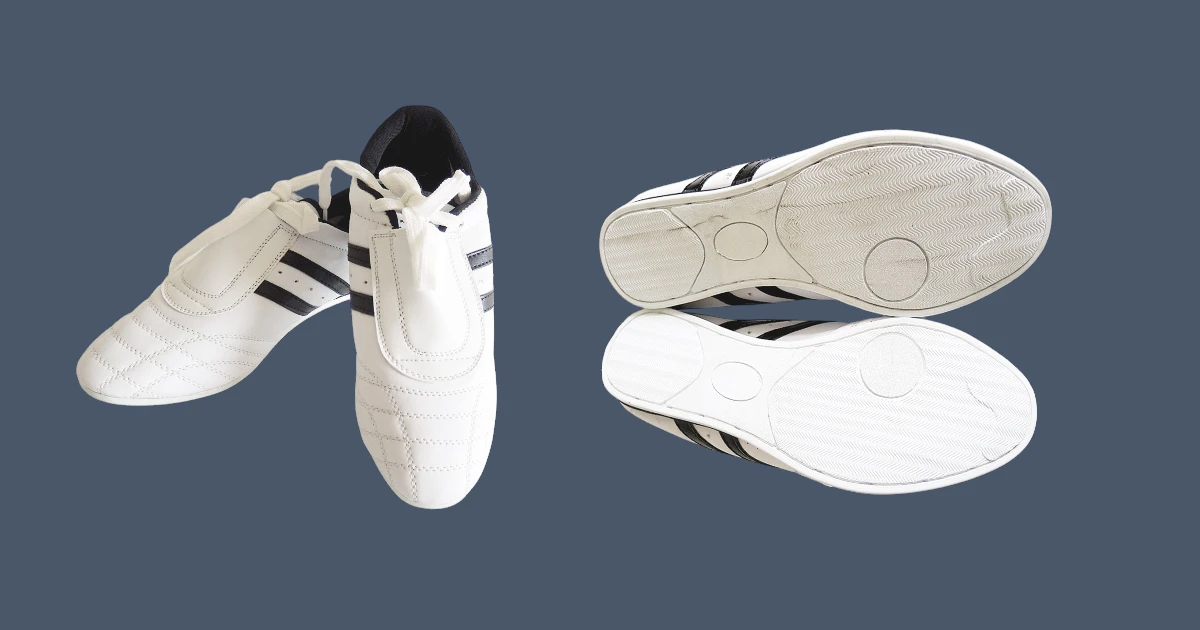
The most important feature. Located on the ball of the foot area of the sole, the pivot point consists of concentric circles or a specialised surface designed to allow smooth rotation during spinning and turning kicks. Without it, pivoting creates friction and drag that slows your turns and stresses the ankle. With it, you can execute multiple spinning kicks with full speed and control. This is the feature that separates a Taekwondo shoe from a generic martial arts shoe or a cross-trainer.
Lightweight construction
A heavy shoe adds load to every kick. Taekwondo shoes are designed to be as light as possible — leather upper with a PVC or rubber sole — so that kick speed is not compromised. When fitted correctly, the shoe should feel like a natural extension of the foot rather than something added to it.
Leather upper
Leather breathes naturally, which prevents excessive sweating and keeps the foot comfortable during long sessions. It also moulds to the shape of the foot over time, improving fit as the shoe breaks in. Leather is durable and easy to clean — a damp cloth is enough for regular maintenance.
Ankle padding
Foam padding inside the ankle area provides comfort and prevents rubbing during repetitive pivoting movements. It also provides mild ankle support that reduces the risk of awkward twists.
Lace closure
Laces allow you to adjust the fit precisely across the width and height of your foot. This is important — a shoe that shifts during a spinning kick is a distraction and a fall risk. Laces tied correctly keep the shoe firmly in place through every technique.
Non-slip sole with flexibility
The sole needs to grip the floor firmly during stances and strikes while remaining flexible enough not to restrict foot movement. PVC and rubber soles balance these requirements — firm grip, enough flex for natural foot mechanics.
Poomsae and Kyorugi
Both forms benefit from Taekwondo shoes for different reasons.
For Poomsae, the leather upper moulds to the foot for comfort during the slow, controlled movements and fast sequences of a pattern. Multiple lines of stitching distribute pressure evenly across the upper so no single area feels excessive stress during held stances.
For Kyorugi, the pivot point is critical. Sparring involves constant direction changes, sudden turns, and spinning techniques that all rely on efficient pivoting. The non-slip sole keeps the foot planted in strategic stances while the pivot point allows instant rotation when needed. Pacific Sports Taekwondo shoes are available in white sole and black sole varieties — both perform identically, sole colour is purely personal preference.
Breaking in new shoes
Leather Taekwondo shoes will feel slightly tight when new — this is normal and intentional. Leather stretches with wear and moulds to your foot. Don’t go straight from new shoes to an intensive training session. Wear them casually for a few days first to let the leather soften and begin to take the shape of your foot. After training, leave them open to air out fully — don’t seal them in your training bag while still warm and damp.
How to find your correct size
Taekwondo shoe sizing is based on foot length in centimetres. To measure accurately:
Place a piece of A4 paper with the short edge against a flat wall. Stand on the paper with your heel touching the wall and put your full weight on that foot. Mark where your longest toe ends. Measure the distance from the wall edge to that mark in centimetres. Check that measurement against the size chart on the product page.
A few sizing notes worth keeping in mind. Most people have one foot slightly larger than the other — always size for the larger foot. Allow at least an index finger’s width of space on either side of your foot within the shoe. The shoe should feel snug but not tight enough to restrict circulation. If you wear thick socks or special inserts, factor that into your size selection.
Pacific Sports Taekwondo shoes are available in European sizes 37 through 48 (excluding 46). Size is measured on the outside of the sole in centimetres.
Care and maintenance
After training, leave your shoes open in a ventilated area for a few hours to air out fully. Don’t close them in your bag while still warm — trapped moisture causes odour and degrades the leather faster. Wipe the leather upper with a dry cloth regularly. The laces can be removed and washed separately when they become dirty. Check periodically for wear on the sole, particularly around the pivot point area — when the pivot point surface wears smooth, it’s time for a new pair.
Frequently Asked Questions
Should I train barefoot or in shoes?
Both. Barefoot training develops the sensitivity, balance, and technique that competitions require. Shoes allow you to train longer and more frequently without accumulating foot injuries. Most experienced practitioners train both ways and choose based on the session length, the training surface, and what they’re working on. Neither approach replaces the other.
Are Taekwondo shoes suitable for Karate?
Yes. The design is suited to any kicking-focused martial art. The pivot point, lightweight construction, and ankle support benefit Karate practitioners the same way they benefit Taekwondo practitioners. Pacific Sports martial arts shoes are marketed as Taekwondo shoes but are appropriate for Karate, Kung Fu, and most other striking disciplines.
How do I know when my shoes need replacing?
Check the pivot point area first — when that surface wears smooth or develops flat spots, the pivoting function is compromised. Also check the sole for uneven wear, the stitching on the upper for fraying, and the ankle padding for compression. If the shoe no longer provides a snug fit because the leather has stretched significantly, it’s time to replace them. A well-maintained pair used in regular training typically lasts one to two years.
Can children wear the same Taekwondo shoes as adults?
Pacific Sports Taekwondo shoes start at size 37. For younger children whose feet are still developing, the same principles apply — proper fit, pivot point, ankle support — but sizing down into the smallest available size may still be too large for very young students. Check the size chart carefully and measure the child’s foot accurately before ordering.
Do Taekwondo shoes work on all floor surfaces?
They’re designed primarily for indoor mat surfaces — the non-slip sole grips mat material well. They also work on smooth wooden or concrete floors. For outdoor training on grass or uneven ground, the leather upper provides adequate protection but the sole grip varies depending on the surface. Avoid training in Taekwondo shoes on wet outdoor surfaces where the sole may not provide sufficient grip for explosive movements.
How do I clean Taekwondo shoes?
Wipe the leather upper with a dry cloth after training and with a lightly damp cloth when more thorough cleaning is needed. The sole can be cleaned with a damp cloth. Remove laces and wash them separately when they become dirty. Don’t submerge the shoes in water — it degrades the leather and the adhesive bonding the upper to the sole. Air dry fully after any cleaning before storing.