Why do martial artists use protective gear?
Martial Arts Protective Gear Australia: What You Need and Why It Matters
Protective gear is not optional equipment — it’s what allows you to train hard, train frequently, and train safely over the long term. An injury that takes you off the mat for weeks or months doesn’t just cost you training time; it costs you the conditioning, the technique, and the momentum you’d built up to that point. The case for wearing proper protective gear isn’t about being cautious — it’s about being able to keep training.
Why protective gear matters
Injury prevention
The most obvious benefit. Protective gear significantly reduces the impact of powerful strikes on the body parts most at risk — hands, shins, ankles, feet, head, and groin. Without it, training at any meaningful intensity accumulates bruises, skin lacerations, cuts, ankle strains, shin contusions, and in more serious cases, ligament tears and fractures. Any of these can keep you off the mat for days, weeks, or months. Good protective gear reduces the frequency and severity of these injuries substantially.
Confidence and focus
When you know your hands and feet are adequately protected, you train differently. You commit more fully to techniques, hit harder, and focus on execution rather than pulling back to avoid hurting yourself or your partner. This isn’t just psychological — it produces genuinely better training outcomes. Protective gear lets you work at the intensity that develops real skill.
Hygiene
This benefit doesn’t get talked about enough. Protective gear acts as a barrier between your skin and training equipment — bags, mats, pads — that accumulate bacteria and fungi across multiple sessions and multiple training partners. It also reduces direct skin-to-skin contact with partners during sparring and clinch work. A dojo that cleans its equipment regularly still can’t guarantee what every training partner has been exposed to. Your personal protective gear is your personal hygiene layer.
Hand protection
MMA gloves
Open and closed thumb MMA gloves protect the knuckles and back of the hand during bag work, sparring, and grappling. The dense padding over the knuckles absorbs impact that would otherwise accumulate in the small bones and joints of the hand. Open thumb gloves give better grip for grappling; closed thumb gives more overall hand protection and reduces eye-contact risk during sparring. Available in medium (7.5–8.5cm across the knuckles) and large (9–9.5cm).
Gel hand wraps
Neoprene wraps with gel padding over the knuckles — a faster alternative to traditional cloth hand wrapping. The 1m length wraps around the hand and wrist securely with Velcro closure. Particularly useful for bag work and as an under-glove layer for added knuckle protection during sparring. Available in red, blue, and black.
Hand mitt guards
Pull-on elasticated mitts with foam padding over the knuckles and back of the hand. Open fingers allow free hand use for grappling and clinch work while providing basic knuckle protection. Lightweight and easy to put on — useful for light contact drilling where full gloves feel like overkill. Machine washable. Available XS through XL — choose a snug fit as they stretch.
Head protection
For Muay Thai, MMA, and Kickboxing sparring, head protection is essential. A quality headgear uses high-density foam padding to absorb and distribute impact, reducing the risk of cuts, bruising, and concussive force. It should have adjustable straps for a secure fit that doesn’t shift during movement, and an open design that doesn’t restrict your field of vision. If your headgear is moving around during sparring, it’s not the right size or not fitted correctly — a headgear that slides over your eyes at the wrong moment is worse than no headgear.
Shin, ankle, and instep protection
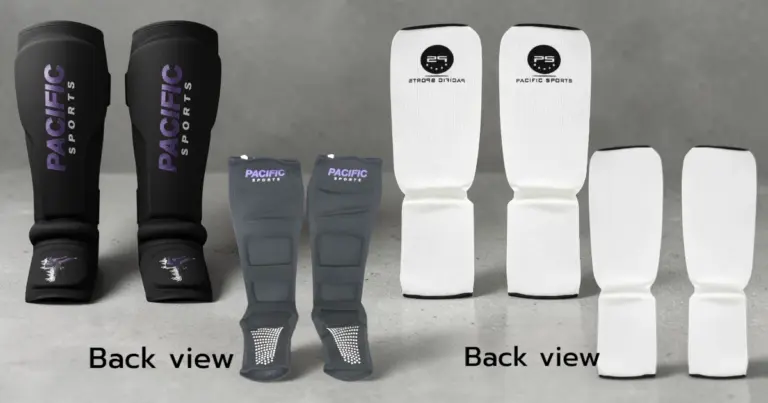
The shin and instep are at risk in any kicking discipline — both from delivering kicks and from blocking them. Pacific Sports offers two types:
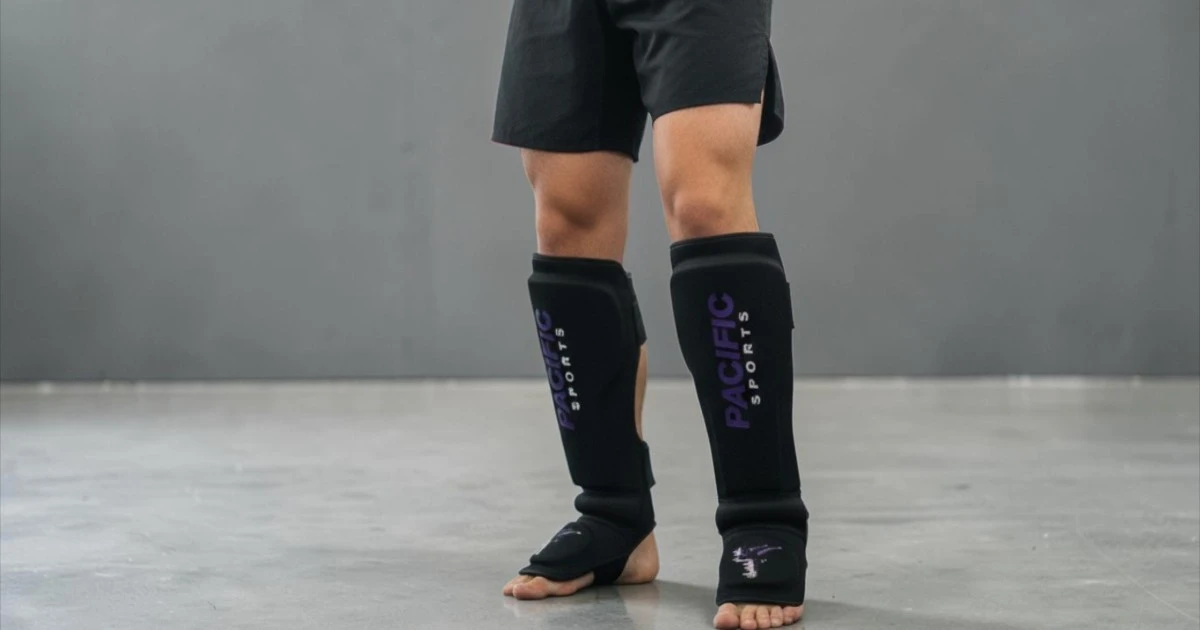
High-density shin-ankle-instep guards
Neoprene outer with strong foam inner and mesh sides for ventilation. Elastic straps at the back hold the guard firmly in place during movement. These provide more robust protection and are better suited to moderate to heavy contact sparring where kicks are landed with meaningful force. The neoprene outer is easy to wipe clean after training.
Pull-on shin-ankle-instep pads
Elasticated cotton outer with impact-absorbing foam inside. Pull straight on without straps — faster to put on and take off, and more comfortable against the skin for extended wear. Better suited to light-contact sparring and drilling where the priority is preventing bruised shins from repeated impact rather than absorbing full-power kicks. Machine washable. Available XS through XL — size for a snug fit.
The pull-on pads are particularly practical for club training where you’re putting them on and off frequently between drills. The high-density guards are the better choice for sparring sessions where kicks are landing harder.
Groin protection
Non-negotiable for male practitioners in any contact discipline. A groin protector needs ergonomic shaping for a secure fit — one that moves with you rather than shifting during explosive movement. Dense padding is the priority. In Muay Thai specifically, where knee strikes to the body are a fundamental technique, groin protection needs to be robust enough to handle knee impact from close range, not just the occasional low kick.
Elbow and knee pads
In Muay Thai, elbows and knees are weapons rather than just joints — which means they’re also targets. Elbow and knee pads reduce injury risk both for the person delivering the strike and for the training partner receiving it. This makes them particularly important in training contexts where you’re working on elbow and knee technique at less than full control. Dense padding that doesn’t restrict the natural range of the joint is what to look for — pads that force you to modify your technique to accommodate their bulk are counterproductive.
Mouthguard
A mouthguard protects teeth and the jaw from impact and should be worn in any sparring involving head contact. Boil-and-bite mouthguards — where you soften the guard in hot water and bite down to create a custom impression — give a significantly better fit than stock sizes. A poorly fitting mouthguard that you’re constantly adjusting is a distraction during sparring. The mouthguard should stay in place through head movement without needing to be clenched to hold it.
Martial arts shoes
Covered in more detail in our dedicated shoes guide, but worth including here: martial arts shoes protect the feet during extended training sessions, reduce the risk of blisters, calluses, and ankle sprains from repeated pivoting on bare skin, and provide hygiene protection in environments where foot infections can transfer through shared mat surfaces. The pivot point on the sole of Pacific Sports Taekwondo shoes specifically supports the spinning and turning techniques central to kicking disciplines.
Care and maintenance of protective gear
Protective gear collects sweat, bacteria, and skin cells during training. Left uncleaned, it becomes a hygiene hazard that undermines the very protection it’s supposed to provide.
Wipe down gloves, shin guards, and hard protective items with a damp cloth after every session. Air dry fully before storing — never seal gear in a bag while still damp. Pull-on pads and hand mitt guards are machine washable — wash regularly, at least weekly if you train frequently. Store gear in a ventilated area rather than a sealed bag between sessions.
Frequently Asked Questions
Do I need all of this gear to start training?
No. What you need depends on your discipline and what stage of training you’re at. Beginners doing technique drilling without live sparring need less protective gear than practitioners doing regular sparring sessions. As a starting point, hand protection and shin guards cover the areas at most risk in most disciplines. Add headgear, groin protection, and elbow/knee pads as your training intensity increases and you begin sparring. Ask your instructor what’s required at your school before buying.
Can I use the same protective gear for different martial arts?
Most protective gear is multi-discipline — Pacific Sports gear is designed for Karate, Taekwondo, BJJ, Muay Thai, MMA, Judo, and other disciplines. The main exceptions are discipline-specific items like Muay Thai headgear designed for elbow contact, or Taekwondo foot protectors designed for the specific impact patterns of Taekwondo sparring. For general training across disciplines, the same gear typically serves well.
How do I know if my shin guards fit correctly?
The guard should cover from just above the ankle to just below the knee. It should sit firmly without shifting when you kick or move laterally. If the guard rotates around the shin during movement, it’s too loose. If it’s restricting your ankle flexion, it’s too long or too tight. For pull-on pads, size for a snug fit — they stretch with wear and a slightly tight pull-on pad is better than one that slides down during training.
How often should I replace protective gear?
When the padding compresses permanently and no longer bounces back, the protective function is compromised — replace it. For gloves, check the knuckle padding regularly; for shin guards, check the foam over the shin bone. Surface wear to the outer leather or neoprene doesn’t necessarily mean the protection is compromised, but flattened or crumbling foam does. Well-maintained gear that’s cleaned and air-dried after every session lasts significantly longer than gear that’s left sweaty in a bag.
Is protective gear required for BJJ?
Standard BJJ training doesn’t use the same protective gear as striking arts — no headgear, shin guards, or groin cups in most club rolling sessions. Rash guards and compression shorts provide skin protection from mat friction. Mouthguards are recommended for competition. Some practitioners wear knee braces or ankle supports for injury management. The protective gear priorities in BJJ are different from striking disciplines because the injury risks are different.
What’s the difference between gel hand wraps and traditional cloth wraps?
Traditional cloth wraps are longer — typically 4.5m — and wrap around the hand and wrist in a specific pattern to support the bones and tendons of the hand. They require practice to apply correctly and take longer to put on. Gel hand wraps are pre-shaped with foam padding over the knuckles and simply wrap and Velcro closed. They’re faster to apply and easier for beginners, but provide less wrist support than properly applied cloth wraps. For bag work and light sparring, gel wraps are practical. For heavy bag sessions and competitive sparring, properly applied cloth wraps provide better wrist support.
In conclusion, investing in high-quality martial arts protective gear Australia is essential for a safe and effective training experience.