How to break in Taekwondo shoes
Taekwondo Shoes: Why You Should Wear Them and How to Break Them In, Especially in Australia
Most martial artists think carefully about their uniform but give little thought to their feet. In Taekwondo particularly, where barefoot training is traditional and most competitions don’t permit shoes, it’s easy to assume footwear is optional. It isn’t — and for training sessions, the case for wearing shoes is stronger than most practitioners realise.
Understanding how to break in your Taekwondo shoes how to break in Australia is essential for optimal performance and comfort.
Four reasons to wear shoes in training
Hygiene
Mats, floors, and changing areas in martial arts schools are shared barefoot spaces. Skin infections and fungal conditions spread easily in these environments — it only takes one student with an undiagnosed skin condition to introduce bacteria or fungi that can transfer to everyone training barefoot in the same space. This isn’t hypothetical — staph, ringworm, and athlete’s foot are documented problems in martial arts training environments worldwide. Shoes eliminate foot-to-floor skin contact during training sessions, which significantly reduces this transmission risk. This is particularly relevant in facilities where the mat hygiene protocols aren’t rigorous, or when training outdoors where surface conditions can’t be controlled.
Physical protection
Not every training facility has ideal flooring. Uneven floorboards, rough concrete, cold floors in winter, and outdoor surfaces all present risks to bare feet that shoes eliminate. During sparring and drilling, the foot is also at risk from accidental impacts — stubbed toes, glancing kicks, and awkward landings all happen more frequently than practitioners expect, particularly in the early stages of training. Shoes absorb these impacts and protect the foot surface from cuts, bruises, and abrasions.
Long session protection
A single barefoot training session is fine. Repeated barefoot training over weeks and months accumulates wear on the soles of the feet — blisters, calluses, and the impact stress that repeated pivoting on bare skin causes. Taekwondo’s emphasis on spinning and turning kicks means the ball of the foot takes particular punishment over time. Shoes protect against this accumulation and allow you to train for longer without foot discomfort becoming a limiting factor.
Training versatility
Some competitions permit foot protectors or shoes. If you’ve trained exclusively barefoot, wearing any footwear during competition feels foreign and disrupts your technique. Training periodically in shoes — alongside your regular barefoot sessions — keeps you comfortable in both situations and prepares you for any competition format.
Why new Taekwondo shoes need breaking in
Here’s something most people don’t think about: your two feet are not identical. Despite appearing symmetrical, the left and right foot have minor differences in width, arch height, and toe length. A factory-made pair of shoes is produced identically — they need time to adjust to the specific shape of each foot, and your feet need time to adjust to the shoes. Leather Taekwondo shoes typically take one to four weeks to fully break in, depending on how often you wear them and how you approach the process. High-quality soft leather like that used in Pacific Sports Taekwondo shoes breaks in faster than stiffer leather — but even soft leather needs some adjustment time before it feels completely natural.
Three practical ways to break in Taekwondo shoes
1. Use plasters or inserts on pressure points
Before wearing new shoes for training, put them on and walk around in them to identify exactly where they’re rubbing or feel tight. Apply plasters directly to those spots on your feet, or use thin shoe cushion inserts at the pressure points inside the shoe. Then wear them for training as normal. This protects the vulnerable areas while the leather softens and moulds — it’s the fastest method and the one most commonly used by experienced practitioners.
2. Wear them around the house first
Before taking new shoes into training, wear them casually around the house for short periods over several days. This lets the leather begin to soften and take the shape of your foot without the intensity of a training session accelerating the process too quickly. When the shoes start to feel comfortable for walking, test a few gentle kicks and pivots. Once those feel natural, the shoes are ready for full training use.
3. Wear socks during the break-in period
Combine this with either of the above methods. Socks take up slightly more space inside the shoe, which helps the leather stretch and mould to your foot shape faster. Experiment with different sock thicknesses — thicker socks if the shoe fits snugly, thinner socks if there’s already reasonable room. Once the shoe has moulded to your foot with socks, it will feel even better without them.
After breaking in: ongoing care
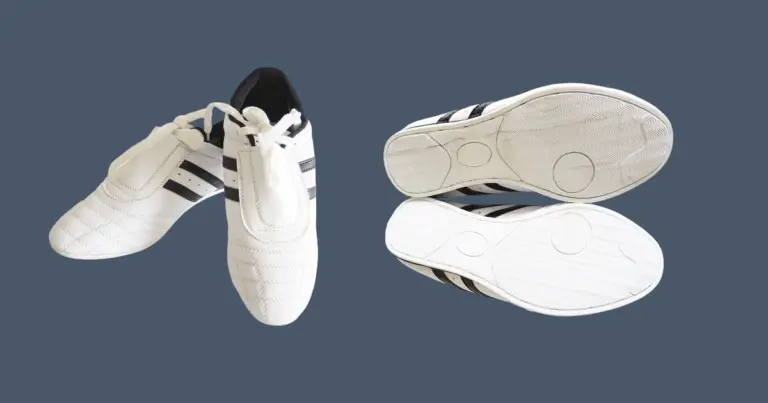
Once your Taekwondo shoes are broken in, a few habits keep them in good condition. After training, leave them open to air out fully — don’t seal them in your bag while still warm. Wipe the leather upper with a dry cloth after each session. Remove laces and wash them separately when they get dirty. Check the sole periodically for wear around the pivot point — when the pivot point surface wears smooth, the spinning and turning function is compromised and it’s time for a new pair.
Frequently Asked Questions
How long does it take to break in leather Taekwondo shoes?
Typically one to four weeks depending on the leather quality, how often you wear them, and which method you use. High-quality soft leather breaks in faster than stiffer synthetic materials. Wearing them daily around the house and using plasters on pressure points during early training sessions accelerates the process significantly.
Should I buy shoes that fit perfectly straight out of the box?
A shoe that feels completely perfect when new is likely slightly too large — leather stretches with wear, so a new shoe should feel snug rather than spacious. A shoe that’s slightly tight in a specific spot will usually resolve during breaking in; one that’s tight across the whole foot or too short in the toe box won’t improve and should be exchanged for the correct size.
Can I speed up the breaking-in process?
The most reliable methods are the three above — plasters, house wearing, and socks. Some people suggest applying heat or freezing shoes to soften leather, but these approaches carry real risks of damaging the leather or the sole adhesive and aren’t reliably effective. Stick to the practical methods and give the leather time to adjust naturally.
Do I need to train barefoot as well as in shoes?
Yes. Barefoot training develops the sensitivity, balance, and technique that competition requires — most Taekwondo competitions don’t permit shoes. The recommended approach is to train in all three ways: barefoot to develop technique, foot protectors to prepare for competitions that permit them, and shoes for long training sessions where foot protection matters. None of these replaces the others.
How do I know when my Taekwondo shoes need replacing?
Check the pivot point on the sole regularly — when it wears smooth and flat, the spinning function is compromised. Also check for sole separation from the upper, significant wear on the heel or ball of the foot, and any cracking of the leather upper. A well-maintained pair used in regular training typically lasts one to two years before the pivot point shows significant wear.
Are Taekwondo shoes hygienic to wear on shared mats?
More hygienic than bare feet, yes — the sole creates a barrier between your foot skin and the mat surface. However, shoes can also track bacteria from outside areas onto the mat if you wear them off the mat surface. The hygienic practice is to wear shoes only on the mat area and remove them when leaving the training space, rather than walking through changing rooms and hallways in them.